Inside Our Jackets
AT ENZO CUSTOM, A JACKET IS DEFINED BY ITS INTERNAL ARCHITECTURE.
Every garment is built around a true full floating canvas—the structural spine of the jacket—running uninterrupted from shoulder to chest, through the lapel, and down to the hem. The canvas is never glued to the outer cloth. It is shaped, tensioned, and refined by hand to create natural chest drape, a controlled lapel roll, and a form that evolves with its wearer over time.
Before assembly, the canvas is shrunk and sculpted using steam and iron work, then allowed to rest and settle before being refined again. This multi-stage process—shaping, resting, and re-shaping—locks in structure that cannot be rushed or replicated by shortcuts, ensuring long-term balance, stability, and durability.
HORSEHAIR, WOOL, & COTTON
We use a best-in-class horsehair blend composed of horsehair, wool, and cotton, selected for spring memory, breathability, and controlled flexibility.
Horsehair provides resilience and shape retention, wool introduces softness and thermal regulation, cotton stabilizes the structure without rigidity.
No synthetic materials are used within the canvassing, preserving breathability, longevity, and traditional tailoring integrity.
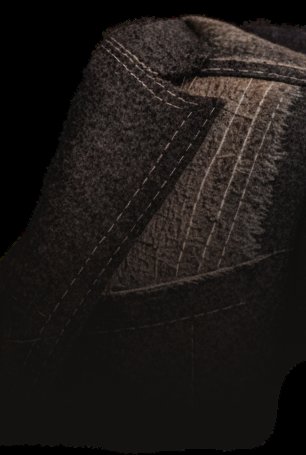
CANVAS DENSITY AND COMPOSITION ARE
matched precisely to the cloth selected. Heavier fabrics require a different internal architecture than lighter ones; structure is calibrated to support the cloth rather than overpower it.
Density is graduated intentionally—firmer through the chest for shape, moderated through the waist for comfort, and lighter through the skirt for fluid movement.
DEDICATED COTTON HORSEHAIR CANVAS AND TRADITIONAL PAD STITCHING
The primary canvas construction begins with a dedicated cotton horsehair blend, selected specifically to match the weight and character of the outer cloth. This foundation is not uniform; density varies intentionally across the jacket, with maximum structure through the chest and shoulders where the garment must hold shape, and moderated density through the waist and skirt for comfort and movement.
The shoulder construction employs a dedicated cotton horsehair canvas layered beneath the outer cloth. This creates the structured but natural shoulder line that defines proper jacket proportion. The canvas is shaped, positioned, and secured by hand-pad stitching—a technique that allows the canvas to move fluidly with the cloth rather than restricting it.
Arm pitch and balance are calibrated during construction to ensure the sleeve hangs correctly from the shoulder. This is not adjusted through alteration; it is built into the garment from the beginning, accounting for your individual posture and the natural hang of your frame.
The lapel is constructed using traditional pad stitching, which secures the canvas while preserving the natural roll and recovery of the cloth. The stitching is performed by hand across the full lapel face, ensuring consistent tension and allowing the lapel to develop character and individuality as the garment is worn.
Sleeves are built with a dedicated sleeve-head structure—a reinforced canvas cap that sits at the top of the armhole. This construction ensures the sleeve maintains its shape, position, and proportional relationship to the jacket body throughout years of wear.
Internal elements include chest pocket reinforcement with dedicated canvas, ensuring pockets maintain their form and function. Welts are finished with precision and reinforced appropriately to the weight of the cloth.
Collars and vents are finished entirely by hand, with attention to balance, grain, and proportion. No aspect of collar construction is automated or rushed.
Interlinings are sourced from Kufner, a German manufacturer renowned for engineering precision and cloth compatibility. The interlining is selected specifically to match the outer cloth weight and hand, ensuring it supports without interfering with the natural drape of the garment.